
How Much Do Bookkeepers Make? Salaries, Hourly Rates, and Business Income Explained
How Much Do Bookkeepers Make? Salaries, Hourly Rates, and Business Income Explained
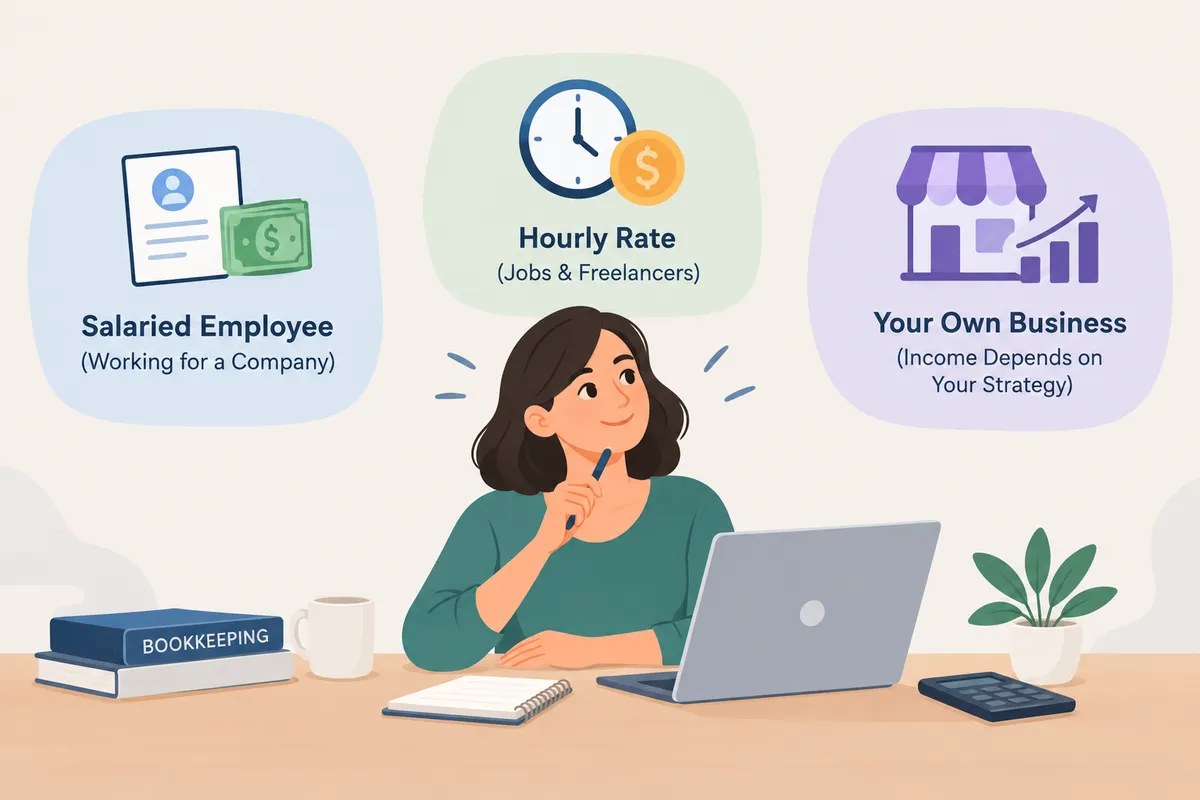
There are really three different questions hiding inside "how much do bookkeepers make." One is about a salaried employee working for another company. One is about an hourly rate, whether that's a job posting or a freelancer's billable rate. And one is about running your own bookkeeping business, where income depends far more on how you price, how many clients you serve, and how efficiently you work than on any national average.
This guide walks through all three, using current wage data, freelance billing benchmarks, and real numbers from people who have built bookkeeping businesses of their own.
How Much Does a Bookkeeper Make a Year
The most commonly cited figure comes from the Bureau of Labor Statistics, which puts the national median wage for a full time bookkeeper at roughly $49,000 to $50,500 per year, or close to $24 an hour. That number holds up across most major salary data sources, including job board averages from Indeed and ZipRecruiter, which land in the same $50,000 range.
Pay narrows or widens quite a bit depending on where a bookkeeper sits on the experience ladder.
An entry level bookkeeper, someone handling data entry, basic reconciliation, and categorization under supervision, typically earns closer to $19 to $22 an hour, or $38,000 to $45,000 a year.
A mid career bookkeeper managing full cycle monthly books, payroll, and multiple accounts independently usually sees $23 to $29 an hour, or $48,000 to $60,000 annually.
A senior or full charge bookkeeper, often the person who prepares books for a CPA's tax review, manages a small team, or specializes in a complex industry, can reach $28 to $36 an hour, translating to $58,000 to $75,000 a year in many markets.
Location plays a large role too. In high cost metro areas such as Washington DC, San Francisco, and parts of Massachusetts and Colorado, hourly pay commonly runs $27 to $31. In lower cost states across the South and Midwest, the same role often pays $18 to $22 an hour. The spread between the highest and lowest paying states in BLS data is close to $18 an hour, which is a meaningful gap for what is largely the same job.
How Much Do Bookkeepers Make an Hour
For anyone comparing hourly numbers specifically, here is how the picture breaks down by employment type.
Type of Work | Typical Hourly Rate |
|---|---|
In-house employee, national median | $23 to $24 |
In-house employee, entry level | $19 to $22 |
In-house employee, senior or full charge | $28 to $36 |
Freelance or contract bookkeeper, billed rate | $25 to $60 |
Freelance, senior or specialized (cleanup, advisory) | $60 to $100 or more |
Offshore bookkeeping assistant | $8 to $15 |
It's worth pausing on the freelance column, because it's easy to compare it directly to an employee's hourly wage and assume freelancers earn two or three times as much. They don't, not really. A freelancer's billed rate has to cover software subscriptions, professional liability insurance, continuing education, marketing, and the hours spent on proposals, invoicing, and client calls that never get billed. Once those costs are subtracted, a freelance bookkeeper billing $40 an hour is often taking home an amount much closer to an employee's wage, just with more flexibility and more risk.
What Actually Moves a Bookkeeper's Pay
A few factors consistently separate the top and bottom of the pay range, regardless of whether someone is employed or self employed.
Certification. A QuickBooks ProAdvisor credential, a Certified Bookkeeper designation from the American Institute of Professional Bookkeepers, or a Certified Public Bookkeeper license through NACPB doesn't guarantee a higher salary, but it consistently correlates with one. Certified bookkeepers tend to land toward the upper half of the hourly ranges above, and freelancers with credentials find it easier to justify rates above $40 an hour.
Specialization. Bookkeepers who focus on a specific industry, such as restaurants, med spas, e-commerce, real estate, or construction, tend to charge and earn more than generalists. Industry specific bookkeeping requires understanding things like inventory costing, tip reporting, or job costing that a general small business bookkeeper won't encounter often, and clients pay a premium for that fluency.
Scope of work. Someone doing pure data entry and reconciliation earns less than someone who also handles payroll, accounts payable and receivable management, financial reporting, and light advisory work. The jump from "record the transactions" to "help me understand what the numbers mean" is usually where pay accelerates.
Employment structure. Full time employees trade a lower hourly number for benefits, stability, and no self employment tax. Freelancers and business owners trade that stability for a higher potential ceiling, more control, and full responsibility for their own overhead.
How Much Can a Bookkeeping Business Make
This is a different question entirely from personal salary, and it's where the numbers get harder to pin to a single figure, because so much depends on the business model.
A solo bookkeeper working alone, with no employees or contractors, typically generates somewhere between $50,000 and $120,000 a year in revenue, and because overhead is minimal (mostly software and insurance), profit margins in that model often run 60 to 70 percent. That means take home pay is frequently close to the revenue figure minus taxes and a modest tech stack.
A solo bookkeeper who brings on contractors to handle overflow work can push revenue into the $100,000 to $250,000 range, though margins compress somewhat, usually landing around 45 to 55 percent once contractor pay is factored in.
A small firm with a handful of employees, standardized processes, and a defined niche can realistically reach $200,000 to $500,000 in annual revenue, with margins in the 30 to 40 percent range once payroll, software, and office costs are accounted for.
At the higher end, established bookkeeping and virtual accounting firms with dozens of recurring clients have reported annual revenue well past $750,000, sometimes into seven figures, particularly when they combine bookkeeping with adjacent services like payroll processing, fractional CFO work, or tax preparation partnerships.
The common thread across all of these models is recurring revenue. Bookkeeping is one of the few small business services where monthly retainer pricing is the norm rather than the exception, and that recurring structure is a big part of why the industry supports healthy margins even with relatively low startup costs, often under $10,000 to get a virtual practice running.
Pricing itself tends to follow business size. Firms commonly charge $200 to $500 a month for businesses under $250,000 in revenue, $500 to $1,500 a month in the $250,000 to $1 million range, and $1,200 to $2,500 or more a month once a client's revenue and transaction volume climb past $1 million. This is one reason a client mix skewed toward growing businesses matters so much to a firm's long term income, since the same number of clients at a higher revenue tier produces meaningfully more monthly revenue.
This is roughly the model behind services like OB Bookkeeping, which prices monthly bookkeeping as a flat, predictable fee rather than an hourly bill, so business owners know their cost upfront regardless of how many transactions or hours a month actually takes.
Salary Vs. Business Income: Why the Numbers Look So Different
It helps to separate two ideas that get blended together in search results. A bookkeeper's salary describes what one person earns doing the work. A bookkeeping business's revenue describes what an entire operation brings in before expenses, salaries, taxes, and reinvestment are subtracted. A firm reporting $400,000 in annual revenue might pay its owner a salary of $90,000 while the rest covers payroll for two employees, software, insurance, and marketing.
So when someone searches "how much can a bookkeeping business make" expecting a personal income number, and instead finds business revenue figures in the hundreds of thousands, the gap isn't a data error. It's two different questions that happen to use similar words.
Frequently Asked Questions
Is bookkeeping a good career financially?
For a stable, benefits eligible role that doesn't require a four year degree, bookkeeping compares favorably to many other entry accessible careers, particularly once certification and a few years of experience are added. The ceiling is higher for those who move into full charge bookkeeping, controller track roles, or start their own practice.
Can you make six figures as a bookkeeper?
It's uncommon as a salaried employee, but achievable as a senior full charge bookkeeper in a high cost market, a specialized freelancer billing premium rates, or a business owner with a firm generating enough revenue to support that level of owner pay.
Is it worth starting a bookkeeping business?
Startup costs are low compared to most service businesses, demand is steady since every operating business needs bookkeeping done, and the recurring monthly billing model supports healthy margins once a client base is established. The tradeoff is that building that client base takes time, typically six to twelve months before income becomes predictable.
Do bookkeepers make more than accountants?
Generally no. Accountants and CPAs require more formal education and licensing and command higher pay as a result. Bookkeeping and accounting are complementary but distinct roles, and many businesses use a bookkeeper for monthly recordkeeping while an accountant or CPA handles tax strategy and filing.
